Related Posts

General News Blog
My WordPress Blog
My WordPress Blog
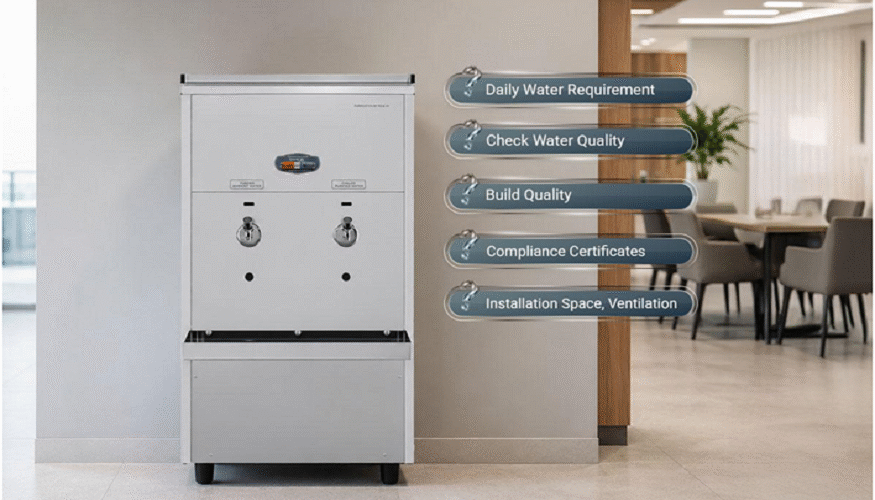
Choosing the best commercial water cooler for a business, school, manufacturing unit, or office involves looking into various operations-based criteria. If one chooses to use a water cooler that is not suited for a facility’s requirements, then very long waiting times will be experienced, along with water that is warm and damaged equipment since the machine is unable to meet the needs of a highly populated office. However, if one goes for a much larger cooling machine, then they will have to incur unnecessary expenses and increased electricity bills.
To choose an appropriate commercial water cooler, companies or institutions should know their water usage patterns as well as times of maximum hourly water consumption and filtration methods used.
In a business environment, water utilisation does not occur uniformly throughout the day. There are periods in which water demand experiences significant increase, e.g.
Read More :
Proper execution of capacity planning guarantees seamless functioning of your unit and offers important advantages, which include:
Uninterrupted Chilling: Eliminates the chance of warm water being dispensed whenever there are many users refilling their bottles simultaneously.
Equipment Longevity: Prevents the compressor and pump from overworking or overheating because there is not enough space to store the water.
Optimised Energy Use: Makes it possible to cool down the water through regular cycles rather than doing it round-the-clock.
To calculate the overall capacity needed, facility managers must observe two indicators: storage capacity (measured in litres) and purification/cooling throughput (measured in litres/hr) for facilities.
As a general benchmark for commercial estimation:
The storage tank for the system must be sufficiently large in order to accommodate peak hourly demands which usually account for 30% to 40% of total daily requirements within two hours. A unit with a suitable large stainless steel storage tank makes sure there is chilled, clean water accessible at all times, even with multiple employees using the water cooler at the same time.
High-TDS sources (borewell or mixed water between 500 –2000 ppm) require Reverse Osmosis (RO) membranes to reduce dissolved salts and heavy metals. Conversely, municipal water supplies with low TDS levels can be processed significantly faster using high-capacity UV e-boiling and multi-stage filtration technologies. Because UV systems disinfect water instantly without requiring membrane-based filtration, they deliver higher flow rates with zero water wastage, making them an ideal, energy-efficient choice for low-TDS environments.
Facilities operating single shifts require higher instant storage to manage concentrated breaks. Multi-shift operations with steady, round-the-clock footfall can rely on high-LPH recovery rates combined with moderate storage tanks.
Analysing the specifications of water purifiers involves checking both capacity and all the important indicators of purification and manufacturing quality:
Managers of facilities when assessing mass hydration systems usually consider water plant price. Evaluating the total amount of investment in equipment has to be evaluated together with the total cost of the water treatment facility. Nevertheless, the total cost of a project depends on some universal criteria.
System Capacity & LPH Rating: Aquaguard commercial water coolers come with defined storage capacities (15.5L, 40L, 80L, 120L) with specific purification and cooling output rates (25 LPH to 120 LPH).
Smart Monitoring & Self-Cleaning Systems: High-tech commercial units come with automated functions, including electronic leak detection These technologies prevent water leakage and internal bacterial growth, thus cutting down long-term maintenance overheads.
The right capacity level for commercial water dispenser units is important, depending on headcount, working environment and day-time peak consumption. The hourly consumption and storage capacity will help businesses to choose an effective and energy-saving water dispenser unit which will provide chilled drinking water in a safe way to staff and guests without unnecessary expenses .